
The field
A field built by its members
The club was founded on 28 September 2004 by twenty-four members, nearly all from the model flying section of the Aero Club di Biella, which had been left without a field after works at the airport.
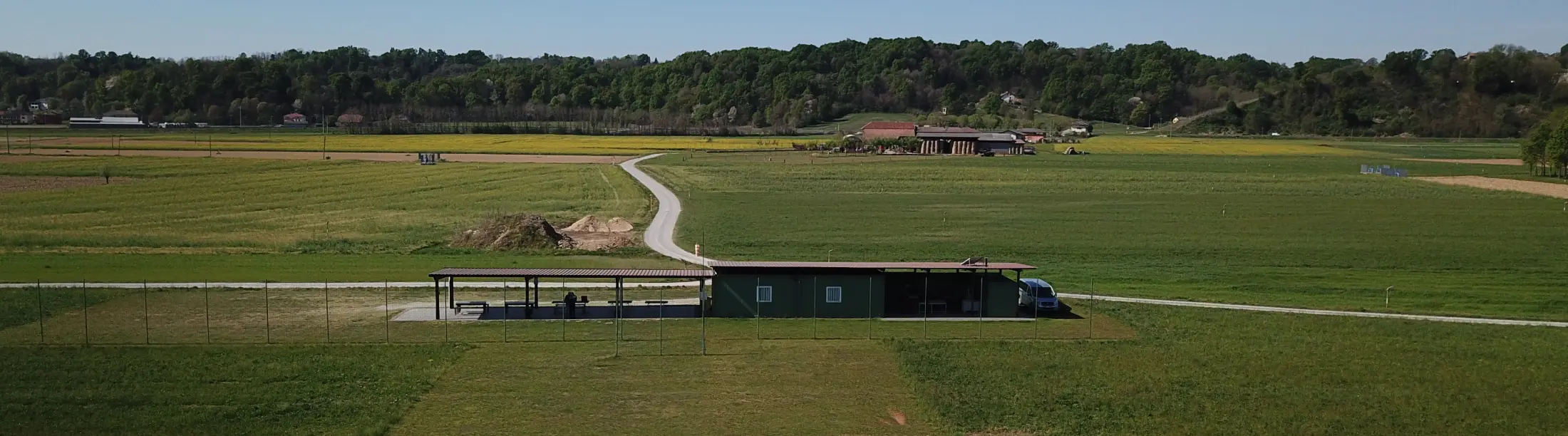
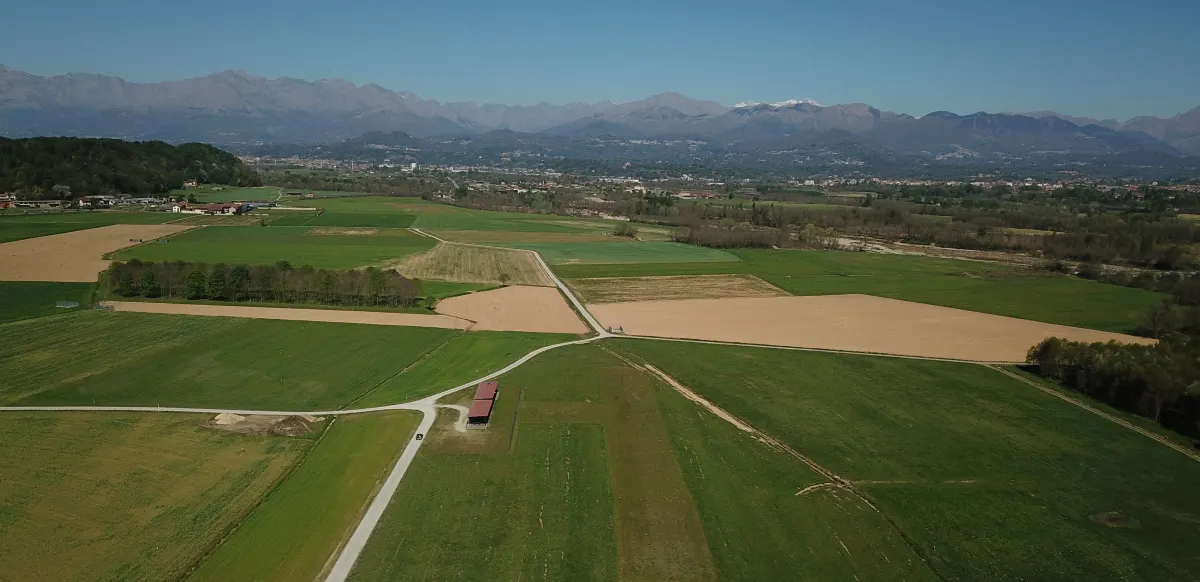
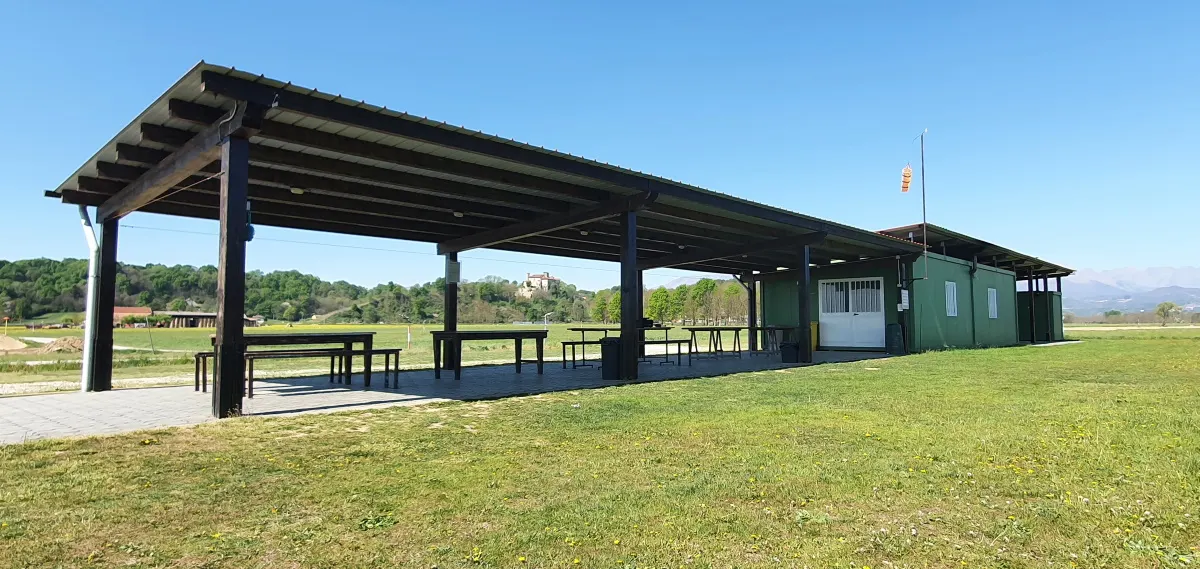
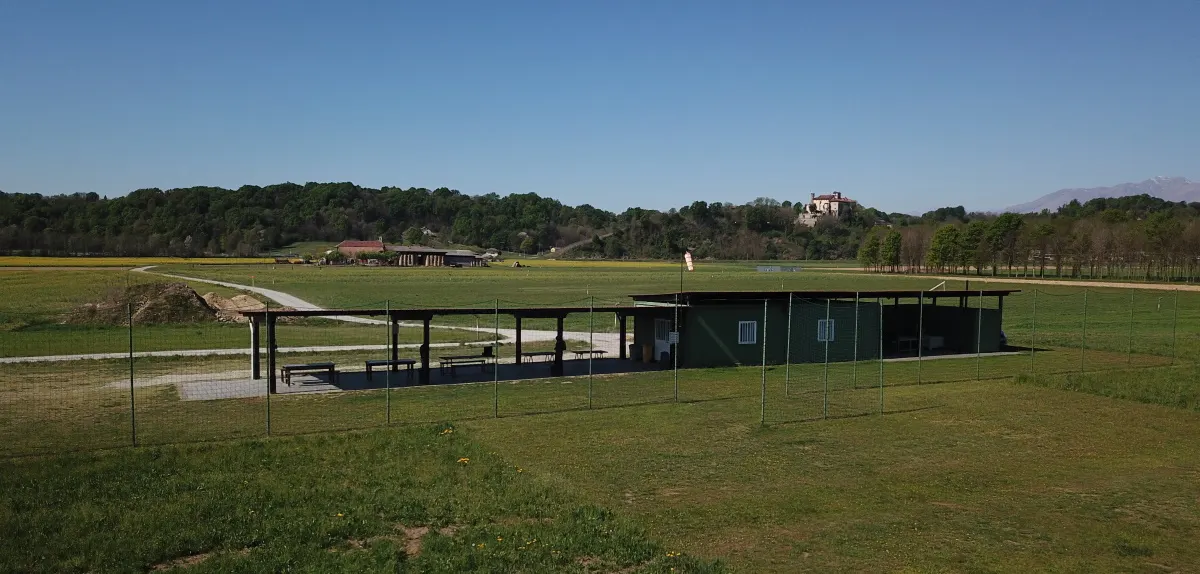
Today we fly on 32,000 m² of meadow in Cossato. The covered shelter, the toilets with drinking water and the equipment came thanks to the Fondazione Cassa di Risparmio di Biella; the members look after the runway and the grass.
- Area
- 32,000 m² · 320 × 100 m
- Runway
- grass, 200 × 20 m
- Orientation
- NNW – SSE, sun behind the pilot
- Covered shelter
- 250 m² · 41 × 6 m
- Meeting room
- heated 60 m² cabin
- Elevation
- 212 m above sea level
Runway 16 heading south-south-east, runway 34 heading north-north-west.
Before you fly
Who can fly, and how
To fly you need
- to be a member with the current year’s fee and model flying insurance paid
- the EASA UAS A1/A3 certificate
- the operator’s d-flight QR code on every model
Anyone who is learning always flies on the “student–instructor” buddy box (trainer system), next to an experienced member.
If you come to visit
- non-members need permission from the operations manager to enter
- stay in the areas reserved for guests, never on the runway
- dogs must be kept on a lead
- the regulations are posted at the field: read them when you arrive
At fly-ins and events open to the public, everyone is welcome at the field: see the calendar.
Want to fly as a guest? Request your passThe areas of the field
The regulations divide the facility into six areas. Only pilots, assistants and the operations manager may enter areas 4, 5 and 6; areas 1, 2 and 3 must never be overflown.
- Entrance and car park
- Guest and refreshment area
- Model assembly
- Engine starting
- Runway, take-off and landing
- Pilot area
Regulations
Flying field regulations
The text approved by the board, which may update it when needed.
Courtesy translation: the Italian text is the binding version.
Operations managers, when present
- Andrea Migliorini
- Giorgio Boario
- Valter Demarie
- Lorenzo Perona
- Andrea Piola
Art. 1General principles
These regulations govern the model flying activities of the Associazione Aeromodellisti Biellesi and of the flying field located at Pobbia, Cossato.
Static and dynamic model flying activities are permitted at the flying field in the form of training sessions, meetings and fly-ins, and amateur sporting events. The activity is inspired by the fundamental principles of the sporting and Olympic movement and by the values of international aeronautical culture.
Every modeller conducts themselves according to the principles of individual responsibility, solidarity with the sporting community, the utmost protection of their own safety, the safety of third parties and of the surrounding environment, loyal cooperation with public institutions and sporting bodies, and compliance with the applicable European and national legislation.
Art. 2Access to the facilities
Access to the facilities and services of the flying field is reserved for members who are up to date with payment of their membership fees. Access to the field is strictly forbidden to non-members, unless authorised by the operations manager or by a person designated by them.
Dynamic model flying activities are reserved for members who hold a valid insurance policy, hold an EASA UAS A1/A3 certificate and have applied to their UAS a proper QR code issued by the D-flight platform, identifying the UAS operator to whom the model belongs. Third parties who are not UAS operators or remote pilots are admitted with the authorisation of the operations manager or of the person delegated by them.
On entering the facility, guests are asked to read a copy of these regulations, posted in a suitably visible place at the facility, to follow the instructions of the operations manager or of the person delegated by them, and to remain in the protected areas, never entering the runway and/or interfering with activities on the ground and in the air. From the moment they enter the facility, every person loses the status of “person not involved in UAS operations” within the meaning of Article 2, paragraph 2, no. 18 of Regulation (EU) 947/2019.
Pets, if present, must be kept strictly on a lead.
Art. 3Operations manager
The role of operations manager is established at the flying field; the operations manager oversees the dissemination and application of these regulations. The operations manager is not liable for any breach of these regulations or of the applicable European and national legislation. In the absence of the operations manager, the first UAS operator or remote pilot to enter the facility becomes the person responsible, until one of the people on the list arrives.
Art. 4Division of the facility
As shown on the attached map, the facility is divided into: 1) entrance and car park area; 2) segregated guest and refreshment area; 3) UAS assembly area; 4) engine starting area; 5) runway and take-off and landing area for fixed-wing and rotary-wing UAS; 6) pilot area.
Art. 5Rules for flying and for preparing to fly
All pre-flight, flight and post-flight operations must be carried out with the utmost safety for oneself and for others.
Areas 4 to 6 may be entered only by the UAS operator, the remote pilot and, when needed, one or more assistants where there are particular requirements, and by the operations manager or the person designated by them.
Before the flight, the operations manager checks the pilot’s mental and physical condition, the weather conditions and the air traffic conditions.
Before switching on the transmitter, the remote pilot makes sure that their frequency is not being used by other modellers present, except when using 2.4 GHz transmitters.
The remote pilot carries out a check before each launch and after landing, paying particular attention to the fastening of wings and control surfaces, engines and propellers, and to the operation of the control devices by cable or by radio, including checking that the movement of all moving parts corresponds to the transmitter controls, as well as the charge level of the batteries and the fuel level in the model, if any. If there is any doubt about the functioning of the UAS equipment, flying the vehicle is forbidden. Batteries must be in good condition and at a level of performance able to guarantee that all phases of the flight are carried out safely. The transmitter must have a low-voltage alarm system.
Model aircraft must be built to standards of efficiency and reliability that offer safety guarantees under normal conditions. In the case of test flights, everyone present must be warned, to ensure that operations are carried out with the utmost safety.
Engines may be started only in areas 4 and 5. Starting any engine with people in the immediate vicinity is strictly forbidden. To start aircraft with internal combustion engines, suitable starters should be used rather than starting by hand. Starting engines while others are flying is forbidden, unless they agree.
Take-off may take place only after checking that the runway is completely clear of people and obstacles. Leaving the runway after landing with engines running or propellers turning is strictly forbidden.
Flying over areas 1 to 3 is forbidden, as is flying over the farmhouse to the south-east of the runway, even though the ENAC regulations would allow it. In the event of accidentally leaving the flying area, the remote pilot lands and carries out a check with the operations manager or with the person delegated by them. The area of use of the UAS must under no circumstances exceed the authorised limits or, where applicable, those set out in the Letter of Operations signed with military or civil Authorities and stated in ENAC authorisation documents of whatever legal form.
Take-off and landing, whether by normal or emergency procedure, must always be announced aloud by the pilot and repeated by the assistant, if there is one. Before landing, the pilot makes sure that the runway is not occupied.
Flying is forbidden in adverse weather conditions that could compromise the ability to control the models.
As a general rule, only one model aircraft may be in the air at a time. The launch of a second model aircraft is authorised by whoever is already flying, unless the operations manager or the person delegated by them decides otherwise.
Multiple flights are allowed provided they are compatible with the safety of the pilots and of everyone present.
Anyone at the facility who spots air traffic that could interfere with flying activities informs the operations manager or the person delegated by them. In the event of a conflict, the remote pilot brings the UAS to a flight altitude that avoids any risk to ordinary aircraft and, if possible, brings the UAS back to the ground. All flying activities must be suspended until the risk conditions have ceased.
In flight, any form of showing off that puts people and property at risk is to be avoided in all areas of the field, including those used for flying.
Art. 6Training criteria
Members who are aspiring modellers must be accompanied by an experienced member acting as tutor until, in the judgement of the operations manager or of the person delegated by them, they have reached an adequate level of autonomy and safety.
Until then, the aspiring modeller carries out flying sessions using the so-called “student–instructor” buddy box (trainer system).
The aspiring modeller informs the operations manager or the person delegated by them that they have completed adequate sessions on a PC simulator, in order to learn the basic manoeuvres and become familiar with the transmitter.
The board of the Association reserves the right to amend these regulations if it considers it necessary.
The President, Andrea Migliorini
The flying zone on d‑flight
On the official d‑flight map the field is the UAS geographical zone «COSSATO (BI)», of the type «Aeroclub and aerial work activities»: it is our field's zone, 300 metres reserved for model flying.
Zones can change: always check the d‑flight map before flying.
The field in pictures
Getting here
Regione Pobbia, frazione Castellengo, Cossato. From the Turin–Milan motorway take the Carisio exit, then the SS232 main road.